You approved the sample. It looked clean, sat flat, and passed your hand check. Then the wear test came back with a red mark along the inner thigh, and a seam that grinned open the moment the tester squatted.
Flatlock joins panels flat on both faces, with nothing to rub. Coverstitch finishes a hem with parallel top rows. Spec each seam by where it sits, not by factory habit.
Two stitches, two jobs. What follows is where each one belongs, and what to put in the tech pack so bulk matches the sample.
WHAT IS THE ACTUAL DIFFERENCE BETWEEN FLATLOCK AND COVERSTITCH?
Both stitches come from the same ISO family, which is where the confusion starts. ISO 4915 sorts stitch types into classes. Class 600 covers the covering-chain stitches, and both coverstitch and flatseam variants sit inside it [1].
The class number will not tell you which stitch is on your garment. The fabric edge will.
ISO 4916 covers seam types separately, which is why a complete spec names both the stitch and the seam [2]. A stitch class alone leaves the factory to choose the join for you.
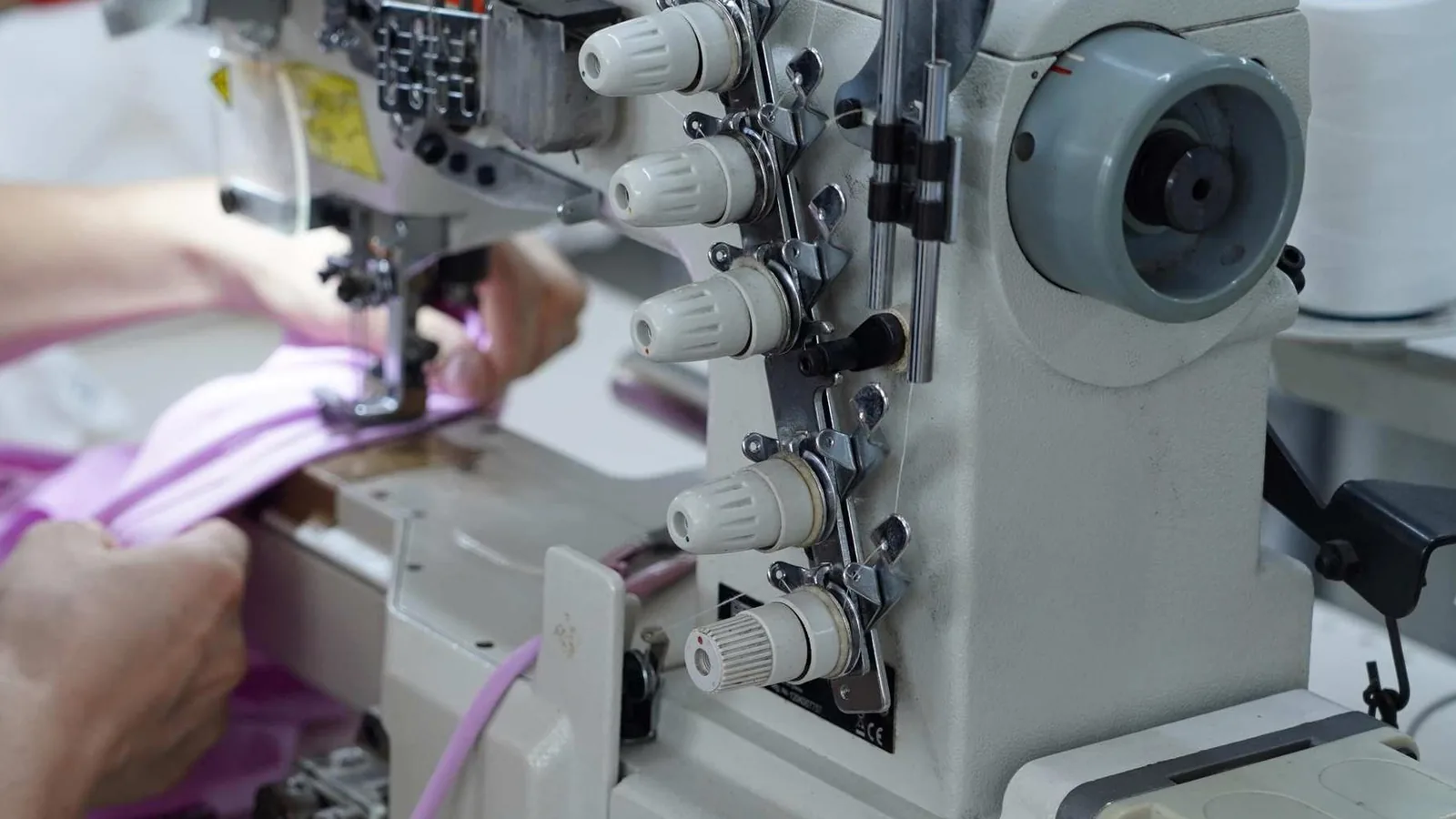
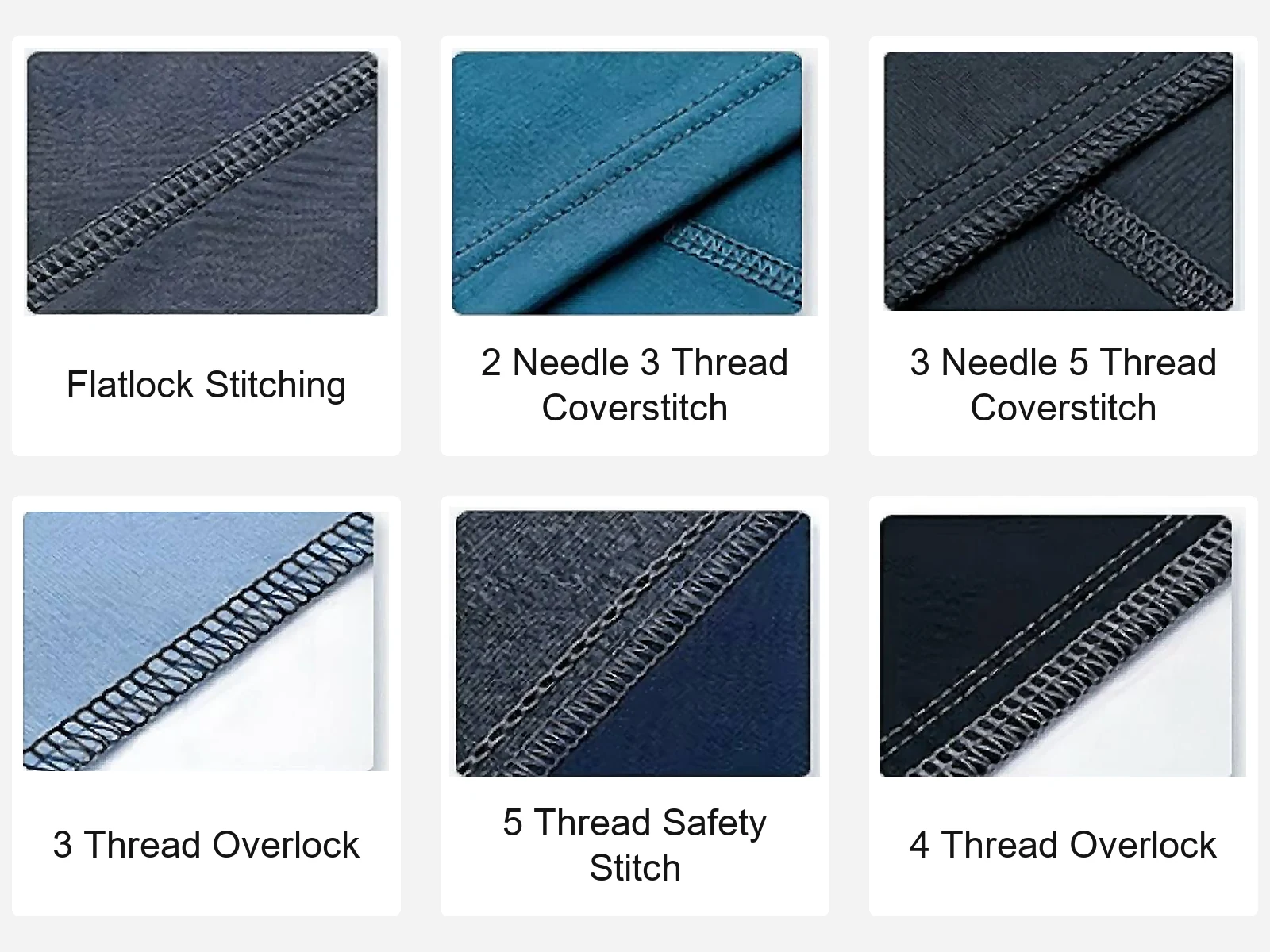
Flatlock butts two trimmed edges together. Needle threads cross the join while looper threads lock them into a ladder, so the seam lies flat on the inside and the outside (Table 1). Nothing is folded into an allowance, which means nothing sits between the fabric and the skin.
Coverstitch works a folded edge instead. Two needle rows run along the face, and a looper thread covers the raw edge underneath. You get a clean, elastic band, but it is a band, with a small build under it.
One stitch joins. The other finishes. Mix them up and you pay twice: once in the sample room, once in the wear test.
| Dimension | Flatlock (class 600 flatseam) | Coverstitch (class 600 cover) | Where it wins |
|---|---|---|---|
| Fabric edge | Trimmed and butted, nothing folded | Folded under, raw edge covered | Flatlock where skin contacts |
| Seam profile | Flat on both faces, thread ladder visible | Two parallel rows on the face, slight band underneath | Flatlock under compression |
| Stretch | High, in both directions | High along the seam | Both are built for knits |
| Bulk | None | Low, but visible | Flatlock on tight fits |
| Chafe risk | Minimal | The band can rub in long sessions | Flatlock at the inner thigh |
| Machine | Dedicated flatseamer, slower | Coverstitch machine, feed-sensitive | Plan machine time, not just price |
| Labor cost | About 30% above overlock (industry estimate) [4] | Medium | Budget by seam, not by piece |
| Typical failure | Grin, needle cutting | Racking, skipped stitch | Each needs its own inspection |
Table 1. Flatlock and coverstitch side by side, and where each one earns its place.
WHICH SEAM ZONES NEED WHICH STITCH?
A legging does not have one seam type. It has zones, and every zone fails in its own way. Start from friction: wherever two panels meet and skin moves against them, you want flatlock.
| Garment zone | Stitch to specify | Why | What to inspect |
|---|---|---|---|
| Front rise and gusset join | Flatlock, four-needle | High friction, high stretch | No grin at twice stretch |
| Inner thigh panel | Flatlock, four-needle | Skin-on-skin contact | Even ladder, no pucker |
| Side panel or mesh insert | Flatlock | Must stay flat under compression | No needle cuts |
| Leg opening hem | Coverstitch, two-needle | Finishes an edge, keeps stretch | No racking, even band |
| Waistband top line | Coverstitch | Elastic edge must recover | No tunneling, no skips |
| Bra neckline and armhole | Coverstitch or binding | Visible finish on the face | Band width, no curl |
Table 2. Seam zones on a legging, bra, or swimsuit, and the stitch each one needs.
Swim adds a zone a legging does not have: the crotch seam, where a four-needle flatlock keeps the join off the body.
If your tech pack says "flatlock" on every seam, it is a wish list, not a specification. Coverstitch belongs on edges that must finish an opening: leg hems, the waistband top line, and the neckline or armhole of a bra or tank.
Table 4. A seam block for the tech pack, matched to the machines on our line.
The test line matters more than most brands expect. ISO 13935-2 measures the maximum force to seam rupture with the grab method, on straight seams only, using a constant-rate-of-extension machine [3].
If your spec says "strong seam", no lab can test it and no factory can be held to it. We run the grab test in-house on our own tensile tester, so a seam card can come back with a number on it.
Approve the seam on bulk fabric, not development fabric. Mills vary lot to lot in stretch and weight, so a seam that passes on the sample roll can grin on the bulk roll. For the fabric side of that decision, see our guide to choosing activewear fabric.
Write the seam block before you approve the first sample. If the rest of the pack is still open, our concept-to-sample checklist covers the document.
KEY TAKEAWAYS
- Flatlock joins, coverstitch finishes. Same ISO class, different job, and different failure modes.
- Map seams by zone. Inner thigh and gusset take flatlock; leg hems and the waistband top line take coverstitch.
- Put a number and a test in the tech pack. Stitch density, thread type, and ISO 13935-2 give the factory something to hit.
A seam you cannot name is a seam you cannot inspect. Naming the stitch is the first QC step, before the first stitch is sewn.
REQUEST A 1-PIECE SEAM SAMPLE
Send us your legging tech pack and target fabric. We will sew a seam card on your bulk fabric, flatlock rise and coverstitch hem, and return it with the stitch settings written on it.
REQUEST A 1-PIECE SEAM SAMPLE →
FAQ
1. Is flatlock stronger than coverstitch?
Neither is stronger by default. Seam strength comes from stitch density, thread type, and how much the fabric stretches. Flatlock wins on comfort; coverstitch wins where an edge has to be finished.
2. Can one factory run both stitches?
Many can, but flatlock needs a dedicated flatseamer and an operator who runs it daily. Ask which machine and who operates it before you approve the sample.
3. Why does my coverstitch hem look wavy?
That is racking, usually caused by differential feed or tension on a stretchy fabric. It will not press out. Re-sew the sample with corrected feed settings.
4. Which colorway should I approve first?
Approve the darkest shade first. A grin is easiest to spot when dark fabric sits against lighter skin, so the darkest colorway is the honest test case.
Buyer FAQ
5. What should I put in the RFQ so quotes are comparable?
Seam zones, stitch class, needle count, stitch density, thread spec, and the seam strength test. Without these, two factories quote two different amounts of machine time.
6. Does flatlock raise my unit cost?
Yes, on the sections where it is used. Industry estimates put it about 30% above overlock in labor [4]. It pays off on skin-contact seams, not on decorative ones.
7. Should I ask for a sewn seam card before the PO?
Yes. A seam card shows every specified seam sewn on your bulk fabric, with settings recorded. It costs one sample and settles arguments before production.
SOURCES
[1] ISO 4915:1991. Textiles — Stitch types — Classification and terminology. International Organization for Standardization.
[2] ISO 4916:1991. Textiles — Seam types — Classification and terminology. International Organization for Standardization.
[3] ISO 13935-2:2014. Textiles — Seam tensile properties of fabrics and made-up textile articles — Part 2: Determination of maximum force to seam rupture using the grab method. ISO. (Revised edition ISO 13935-2:2026.)
[4] FexWear. A Buyer's Guide to Sewing Stitches for Custom Sportswear Manufacturing. https://fexwear.com/a-buyers-guide-to-sewing-stitches-for-custom-sportswear-manufacturing/
[5] IOSR Journal of Polymer and Textile Engineering. Investigating Seam Strength and Seam Performance with Different SPI on Different Fabrics, 6(2), 32–41. https://iosrjournals.org/iosr-jpte/papers/Vol6-Issue2/E06023241.pdf
ABOUT LAVYSEN
Lavysen is an activewear manufacturer based in Ningbo, China, specializing in OEM / ODM private-label yoga wear, sports bras, tennis apparel, and swimwear. We work with US and European fitness and fashion brands from tech pack through bulk production, with controlled quality at every stage.