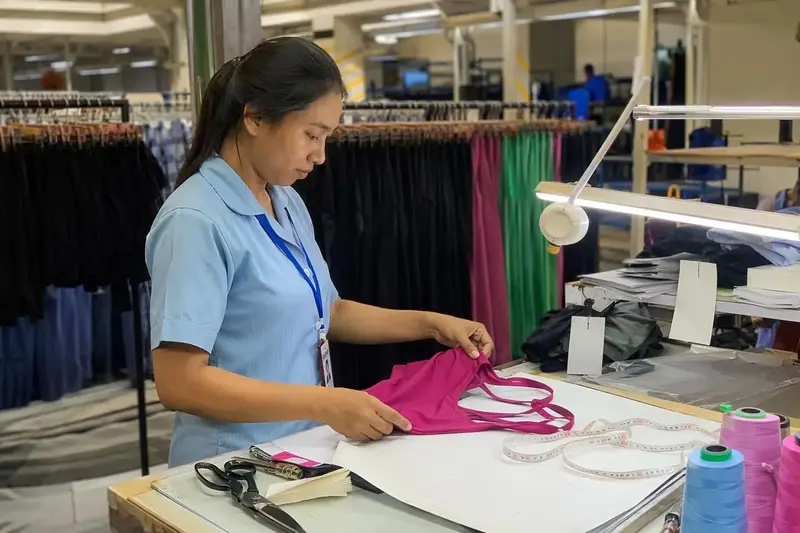
Your first 3,000-piece order lands. The factory email says production passed, and the report shows a green "PASSED." Yet when you unpack the cartons at your warehouse, a handful of leggings twist, three prints are off-center, and one sports bra has a broken seam. What happened?
AQL 2.5 per ISO 2859-1 means that from a 1,000-piece lot, we inspect 80 pieces and accept no more than 5 defects. Everything below is about how to read that report, choose the right level, and keep defects out of your cartons.
What Does AQL 2.5 Actually Mean?
AQL stands for Acceptable Quality Limit — the maximum number of defects considered acceptable during a random sampling inspection. It is defined in ISO 2859-1:1999[1], the sampling standard used by most garment factories and third-party inspection companies (the United States version is ANSI/ASQ Z1.4[2]).
Two ideas drive it. First, opening every single garment in a 5,000-piece order is expensive and slow. Second, checking one or two pieces tells you nothing. So the standard samples a fixed number of pieces by lot size, and accepts the whole shipment if defects stay under a pre-agreed threshold.
The point most new buyers miss: AQL is not a quality bar set by the factory. It is a risk agreement set by you, in the contract. A premium denim brand and a promotional t-shirt brand do not need the same AQL, and neither is "right" without a context of price, category, and customer expectation.
How Do Factories Classify Defects?
Every garment factory separates defects into three buckets, and each bucket carries its own limit. Reading the report means reading all three rows at once.
Table 1 — Defect classes in apparel inspection
| Defect class | What it means | Typical AQL | Activewear example |
|---|---|---|---|
| Critical | Safety, legal, or use-blocking | 0 (zero tolerance) | Needle left in a garment; major fabric tear; wrong fiber-content label |
| Major | Unsellable as intended — function, fit, or appearance clearly wrong | 2.5 (standard) | Broken crotch seam; zipper fails; print shifted >1 cm; wrong size label; see-through dark leggings |
| Minor | Slightly off spec; customer unlikely to notice | 4.0 (standard) | Loose thread; shade within tolerance; minor loose stitching at neckline |
A shipment passes only when all three rows stay under their limits at the same time. One Major at the limit and the rest zero still passes; one Critical anywhere fails the entire lot, full stop.
Which AQL Level Fits Your Activewear Brand?
Most buyers copy "2.5 / 4.0" from a supplier template without thinking. Activewear deserves a second look, because its failure modes are different from a cotton t-shirt: fabric must stretch and recover, seams must flex without splitting, and see-through fabric on dark leggings is an instant return.
Table 2 — Choosing the right AQL level by product
| Your product | Critical | Major | Minor | Why |
|---|---|---|---|---|
| Premium yoga / running leggings, sports bras | 0 | 1.0 | 2.5 | Stretch, opacity, and seam flex are core to the product |
| Standard activewear, private label | 0 | 2.5 | 4.0 | Industry default; matches typical price point |
| Promotional basics, loose-fit tees | 0 | 2.5 | 4.0 | Appearance-driven, not function-driven |
| Accessories (socks, hair bands) | 0 | 4.0 | 6.5 | Low unit price, low functional risk |
One caveat: tighter AQL raises inspection cost and rejection risk on every batch — and re-inspection days can push your delivery date. Match the level to your price point and customer expectation, not to the highest number you can negotiate.
How Is a Lot Sampled Under ISO 2859-1?
The standard uses General Inspection Level II as the default for apparel. You do not choose the sample size directly; you choose the lot size, and the standard assigns a sample size code letter[1]. The table below shows the accept/reject thresholds buyers see most often.
Table 3 — Sample size and accept/reject numbers (Level II)
| Lot size (pcs) | Sample size | AQL 2.5 accept / reject | AQL 1.0 accept / reject |
|---|---|---|---|
| 501–1,200 | 80 | <=5 / >=6 | <=2 / >=3 |
| 1,201–3,200 | 125 | <=7 / >=8 | <=3 / >=4 |
| 3,201–10,000 | 200 | <=10 / >=11 | <=5 / >=6 |
The inspector works through the pieces in a fixed order: carton randomization, measurement of key sizes, visual defect check on both sides, functional tests (stretch recovery, zipper pull, fabric opacity against a light box), and packaging review. If the count lands between accept and reject, the standard tells the inspector exactly what to do — not what feels right.
Why Do Buyers Still Find Defects After a Pass?
This is the most common complaint we hear, and it is almost always one of four causes.
- The sample was drawn from the wrong cartons — if the inspector only checks cartons at the top of the pallet, the randomness fails
- Defects are batch-clustered, not evenly spread — a broken sewing machine for 40 minutes produces 40 consecutive bad pieces, and an 80-piece sample may simply miss them
- The AQL level was agreed without the factory defining which defects count as Major
- AQL only covers what the checklist names — a leaky seam not on the checklist is not a defect in the report
The fix is boring but effective: attach your own defect classification sheet to the inspection report, request carton-level photos during the pull, and add 3–5 activewear-specific functional checks (opacity test, crotch seam stretch test, waistband recovery) that generic reports skip.
What Should You Put in Your QC Checklist?
Run this list before bulk starts, and every item becomes a line on the inspection report.
- AQL level written in the purchase order — Critical 0, Major and Minor per your product category in Table 2
- A signed defect classification sheet naming what counts as Major in your activewear
- Functional tests on the checklist: opacity, stretch recovery, seam flex, zipper pull
- Inspection photos: random carton pull, measurement points, light-box opacity check
- A clear re-inspection rule if the lot fails — cost, timeline, and who pays
Key Takeaways
- AQL 2.5 means 80 samples from a 1,000-piece lot with no more than 5 defects accepted — it is a risk agreement, not a zero-defect guarantee
- Activewear deserves tighter levels than promotional basics: Major 1.0 / Minor 2.5 for premium leggings, not the generic 2.5 / 4.0
- The defect classification sheet and the functional checklist matter more than the AQL number itself
A passed report is a signed risk agreement, not a promise of perfection. Write the defect list, agree the level, and the statistics do the rest.
FAQ
1. Is AQL 2.5 "good quality"?
It is the industry default for standard apparel, not a quality judgment. Premium leggings brands usually tighten Major to 1.0; promotional basics often stay at 2.5. The right number depends on price point and customer expectation.
2. Does a passed AQL inspection mean zero defects?
No. It means the sampled defect count stayed under the agreed limit. On an 80-piece sample at AQL 2.5, up to 5 defects out of 80 is acceptable — the remaining 920 pieces were not opened.
3. Can we inspect 100% instead of AQL?
Yes, for small or high-risk runs (100–300 sample orders). It costs roughly 2–4 times the sampling fee and adds days to the schedule. We usually recommend 100% for the first sample run of a new style, then sampling for repeat bulk.
4. Who pays for re-inspection after a failed lot?
In most OEM agreements, the factory pays re-inspection cost after a failed result, and the buyer pays when a lot already passed. Put this in the contract — it is rarely disputed once written down.
5. How do we add AQL to our RFQ without sounding like a beginner?
Write one line in the purchase order: "Inspection per ISO 2859-1, General Level II: Critical 0 / Major [your level] / Minor [your level], with attached defect classification." That single line puts you in the same language as any third-party inspection company.
6. Should we hire a third-party inspector or rely on factory QC?
Use factory QC for every run, and a third-party (SGS, Bureau Veritas, Intertek) for your first bulk order per style, or when a repeat issue appears. The factory report protects process; the third-party report protects trust.
7. What defect threshold should we set for see-through leggings?
Define it as a Major with a concrete test: single-layer fabric against a standard light box must not show skin tone. Vague wording ("not see-through at all") gives the inspector no way to call it.
Sources
[1] ISO. 1999. ISO 2859-1:1999 — Sampling procedures for inspection by attributes — Part 1: Sampling schemes indexed by acceptance quality limit (AQL) for lot-by-lot inspection. International Organization for Standardization.
[2] ANSI/ASQ. 2003. ANSI/ASQ Z1.4-2003 — Sampling Procedures and Tables for Inspection by Attributes. American Society for Quality.
[3] LAVYSEN internal QC records (2025–2026): defect classification, AQL levels, and inspection practice across activewear categories — factory first-party data.
Request an Inspection Plan
You have the checklist. Send us your style and target lot size, and we will respond the same day with the inspection plan — AQL level, defect classification, and functional tests — in writing, before bulk starts.
Get a custom quote
Request a 1-piece sample
Related reading from LAVYSEN Insights:
How to Choose the Right Fabric for Your Activewear Brand
Inside an Activewear Factory: What to Review Before You Order
From Concept to Sample: What to Prepare Before the First Activewear Order
About LAVYSEN
LAVYSEN is a manufacturer of activewear and yoga wear with our own sample room, pattern team, and production line. We develop OEM, ODM, and semi-custom projects for brands in Europe and North America — 1,000+ styles made from concept to bulk, with samples, size specs, color cards, and test reports included.