Inside an Activewear Factory: What to Review Before You Order
You have compared quotes for three weeks. The price is right and the emails are polite. Now comes the part most buyers skip: checking what actually happens behind the factory gate. One hour on the floor — or on a live video tour — tells you more than thirty email threads.
Review four areas in the same order every time: people and skill, machines and maintenance, QC checkpoints, and documentation. Most red flags hide in the paperwork, not the showroom.
Why See the Factory Floor Before You Order?
Every factory can send photos. Few can answer questions about their own floor without checking a file. A visit — or a live video walk-through — verifies the four things that decide whether your order arrives on time and passes inspection.
We run our own cut-and-sew operation in Ningbo, Zhejiang[4], and we hold current BSCI and ISO 9001 certificates[2][3]. None of that matters if you do not know what to look at. So here is the exact review we walk every buyer through — in order.
People and Skill: Who Sews Your Order
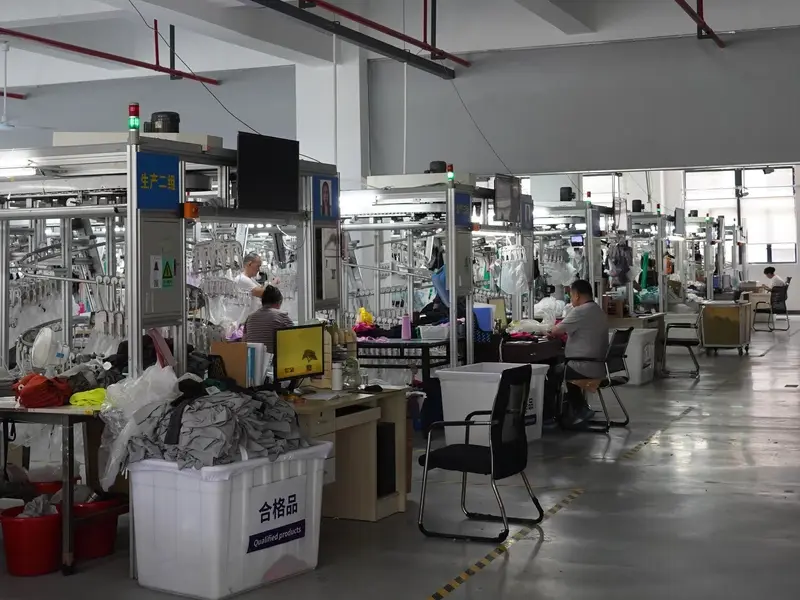
Walk to the sewing floor first. Count the operators, watch how they handle a seam, and ask where the sample room is. Skill shows in small things: how flat a flatlock seam lies, how even the stitch density is, whether an operator adjusts tension or just pushes fabric through.
If a factory shows you a showroom and avoids the floor, that is your first red flag.
| Area | What to look at | Red flag |
|---|---|---|
| People and skill | Sample room, operator count, seam quality on the line | Showroom tour only; floor “not open today” |
| Machines and maintenance | Machine types, maintenance log, spare parts | Rusted, unmaintained, or no records |
| QC checkpoints | Incoming fabric check, in-line inspection, final AQL | Only a final check before shipment |
| Documentation | Business license, audit reports, test reports, TCs | Refuses to show originals |
Table 1 Four areas to review on a factory visit
Machines and Maintenance: What a Working Line Looks Like
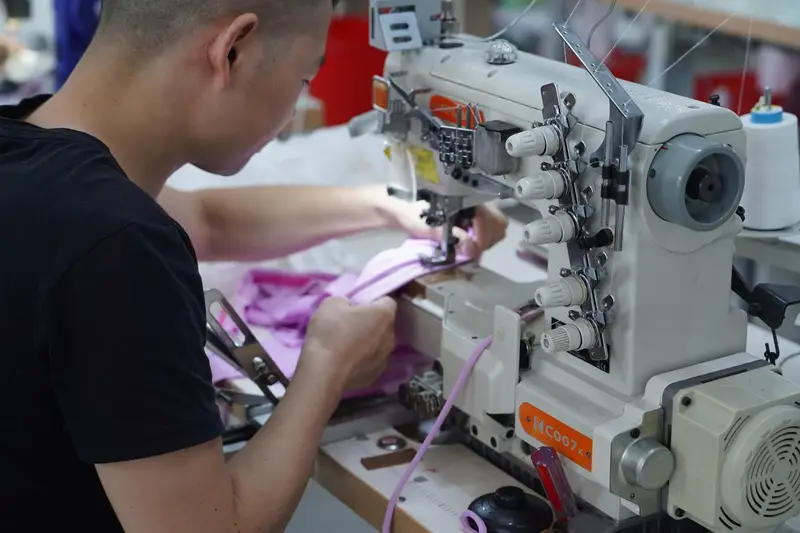
Machines matter less than what is around them. Ask to see the maintenance log and the spare-parts stock. A line with broken machines and no records will cost you delays, not savings.
For knit activewear, the machines you want to see are flatlock machines, overlock machines, and pressing tables. Our floor runs 9 production lines with an in-house pattern and sample room[4].
QC Checkpoints: Where Quality Is Decided
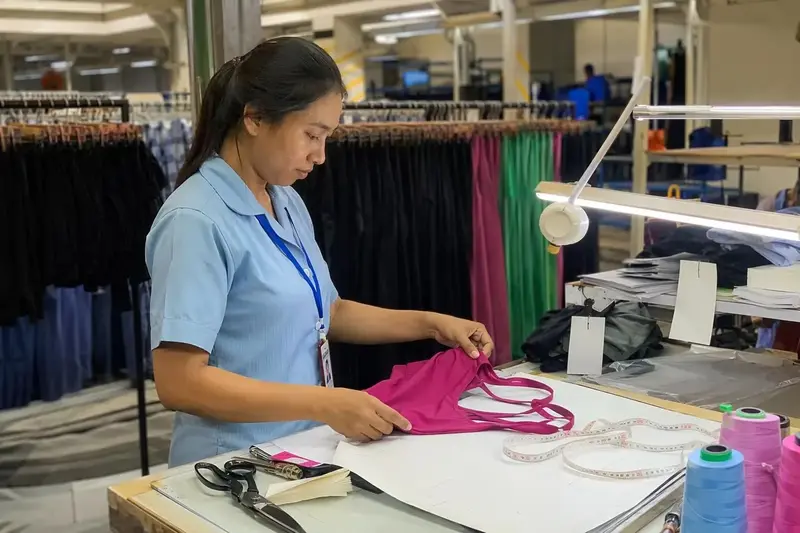
Quality is decided before the final check, not at it. Ask the QC team for their checkpoint records: incoming fabric, in-line checks, and final inspection.
We inspect in three stages: incoming fabric (weight, color, shrinkage), in-line checks during production, and final inspection to AQL 2.5 per ISO 2859-1[1]. The short version: random samples, clear accept-or-reject numbers, and written records on every order. Ask how many pieces were checked on your last order and what the failure rate was — a factory with no numbers to share is a factory with nothing to hide behind.
| Stage | What is checked | Typical failure if skipped |
|---|---|---|
| Incoming fabric | GSM, color shade, shrinkage | Fabric batches do not match |
| In-line (during production) | Seam quality, stitch density, symmetry | Issues found only after bulk |
| Final (AQL) | Random sample per AQL 2.5 | Size deviations, defects in finished goods |
Table 2 The three QC checkpoints
Documentation: The Paperwork That Predicts Your Order
Most red flags are not on the floor — they are in the files. Ask for these documents and look at the dates, not just the stamps.
| Document | Why it matters | What to check |
|---|---|---|
| Business license | Verifies the legal entity | Name matches your contact |
| BSCI / ISO audit reports | Social compliance and quality system | Current date, valid scope |
| Fabric test reports | GSM, stretch, color fastness | Dated within the last year |
| Transaction certificate (GRS) | Links recycled material to your order | Batch number matches your order |
Table 3 Documents to ask for
A business license shows the legal entity. Current BSCI and ISO audit reports show social compliance and quality systems[2][3]. Fabric test reports should be dated within the last year. If you order recycled materials, ask for a transaction certificate (TC) for your batch — that is the only document that links your order to the certified material. Keep copies of everything you sign: a factory that hesitates to give you a written record of your order's test results is telling you something.
The 10-Point Factory Review Checklist
Take this list on the visit. Ten questions, one hour, and you will know more than most buyers do after a year of emailing.
| # | Check | Why it matters |
|---|---|---|
| 1 | Confirm the legal entity on the business license matches your contact | Stops payment going to a shell company |
| 2 | Walk the sewing floor, not just the showroom | Verifies production actually happens here |
| 3 | Count QC staff and ask where they sit during production | Shows whether quality is checked, not just claimed |
| 4 | Ask for the maintenance log of key machines | Predicts delays from breakdowns |
| 5 | See the sample room and meet the pattern maker | Confirms sampling and grading ability |
| 6 | Ask for incoming-fabric check records (GSM, color, shrinkage) | Catches batch mismatches early |
| 7 | Ask for in-line inspection records from a current order | Shows checks happen during production |
| 8 | Ask how final inspection is done (AQL 2.5 per ISO 2859-1) and ask to see a report | Verifies the acceptance standard |
| 9 | Check audit reports are current and the scope covers cut-and-sew activewear | Confirms BSCI and ISO 9001 certificates are valid for your product |
| 10 | For recycled materials, ask for the transaction certificate of your batch | Protects your sustainability claims |
Table 4 10-point factory review checklist
Buyer FAQ
Do I need to visit in person, or is a video call enough?
A live video walk-through with a real floor view is a good first step. For your first bulk order, an in-person visit or an independent third-party inspection is worth the cost.
What if a factory says the floor is “not open to visitors”?
That is a red flag. Honest factories open the floor on request — we offer live video tours on demand.
How much does a factory visit cost?
For serious buyers, most factories — including us — arrange local transport, accommodation and a factory guide. You only cover your international flights; we take care of everything once you land.
What is AQL 2.5?
AQL (Acceptance Quality Limit) 2.5 per ISO 2859-1:2026 is a sampling plan: a set number of pieces are drawn randomly and checked against clear accept-or-reject rules.
Do you share audit reports?
Yes. We hold current BSCI and ISO 9001 certificates and share them with verified buyers on request.
Sources
[1] ISO 2859-1:2026, Sampling procedures for inspection by attributes — Part 1: Sampling schemes indexed by acceptance quality limit (AQL) for lot-by-lot inspection. https://www.iso.org/standard/85464.html
[2] ISO 9001:2026, Quality management systems — Requirements. https://www.iso.org/standard/9001
[3] amfori BSCI (Business Social Compliance Initiative) — Code of Conduct & System Manual, 2022 edition. https://www.amfori.org/amfori-bsci
[4] LAVYSEN factory, Ningbo, Zhejiang — in-house audit records and QC documentation, reviewed October 2026.
Ready to review a factory the right way? Request a 1-piece sample or a live video walk-through of our floor — we will show you the same four areas, in the same order. [Contact our team] (https://www.lavysen.com/contact/).