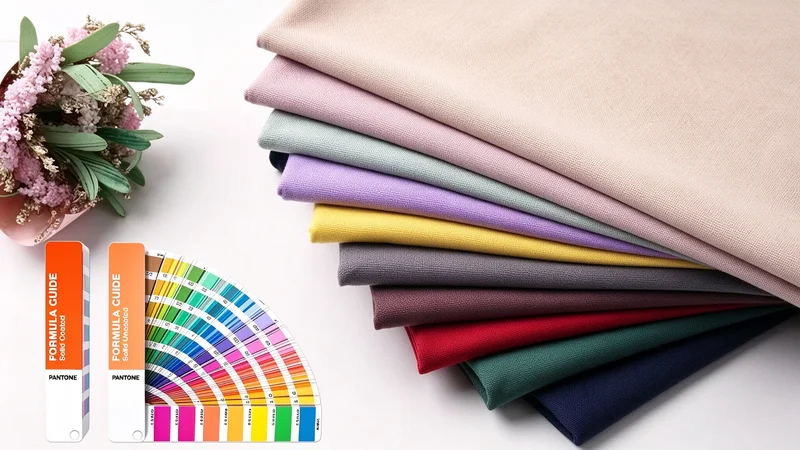
How to Choose the Right Fabric for Your Activewear Brand
The fabric feels incredible in your hand. The supplier calls it buttery soft. But nobody can tell you what that means in numbers — or what it will feel like after twenty washes and a season of squats.
Choose fabric in five steps: lock your use case, read the fiber mix, set the GSM, demand stretch-and-recovery data, and freeze one fabric code per style. Everything below is the how.
What Actually Matters in an Activewear Fabric?
Buyers who email us “just soft” usually get the wrong sample. Soft is a feeling; a spec is a fact. Before we recommend anything, we ask four questions, and you should ask them of every supplier:
- Use case. Yoga, training, or lounge? A 180 gsm jersey that feels lovely as a tank will collapse as a high-support legging.
- Handfeel target. Naked-feel, compression, cool-touch, or brushed? Each maps to a different fabric family.
- Color and opacity. Light colors need a higher GSM or a double layer — opacity is not a promise, it is a spec under stretch conditions.
- Budget tier. Entry polyester, mainstream nylon blends, or premium finished nylon? The fiber mix is where your price point is born.
A fabric is “right” only when four numbers are written down: composition, GSM, stretch, and recovery — plus a test report you can read[2]. If a supplier only answers with adjectives, ask for the numbers in writing.
Nylon, Polyester, or a Blend? How to Read Fiber Composition
Fiber names are standardized: ISO 2076 sets the generic names for man-made fibers, so “nylon” and “polyester” mean the same thing to every mill[1]. Three fibers do most of the work in activewear, and a fourth shows up in sustainability lines.
Nylon (polyamide) is the workhorse of premium leggings: soft, abrasion-resistant, and it recovers well. Polyester is cheaper, dries fast, and holds a shape, but feels stiffer and pills more under friction. Spandex (elastane) is not a body fabric — it is the elastic engine, usually 15–25% of the mix. Too little and the garment fights your movement; too much and it sags after a few washes.
| Fiber | Feel | Strengths | Watch out | Best for | Cost |
|---|---|---|---|---|---|
| Nylon (polyamide) | Soft, smooth | Durable, recovers well, abrasion-resistant | Pricier; dyeing needs care | Leggings, bras, naked-feel lines | Mid–high |
| Polyester | Dry, crisp | Low cost, quick-dry, holds shape | Stiffer; less breathable; pills | Entry basics, performance tops | Entry |
| Spandex (elastane) | Stretch source | 15–25% gives movement and recovery | Too much = sagging after washes | Blended into all stretch fabrics | — |
| Recycled nylon / polyester | Varies | Certified content, brand story | Slightly lower strength; deep dyes harder | GRS lines, sustainability ranges | High |
Table 1 Fiber cheat sheet
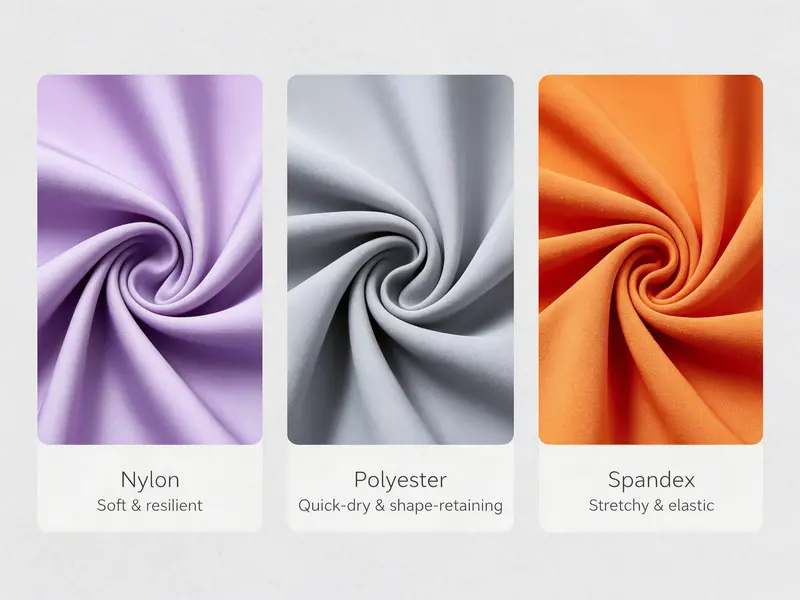
When a buyer names a handfeel we already have in stock, we match to the closest code instead of developing from zero. That is how sample costs stay down — and it is why a fabric library with real codes matters more than a wall of adjectives.
GSM: The Number That Decides Opacity and Weight
GSM is grams per square meter — the weight of the fabric, not its quality. In activewear, yoga leggings usually sit between 180 and 250 gsm; 220 is the mainstream naked-feel zone[4].
The trap is opacity. A 180 gsm light-colored legging can go see-through the moment it stretches. That is why we advise 200 gsm or above for light shades — the industry rule of thumb[4].
| GSM | Feel | Best use | Watch out |
|---|---|---|---|
| 180 | Light, cool | Tanks, tops, entry leggings | Lighter colors can go see-through |
| 220 | Naked-feel mainstream | Leggings, bras | Balance opacity vs heat |
| 260 | Compression | High-support leggings, shaping | Heavier = hotter in summer |
Table 2 GSM guide
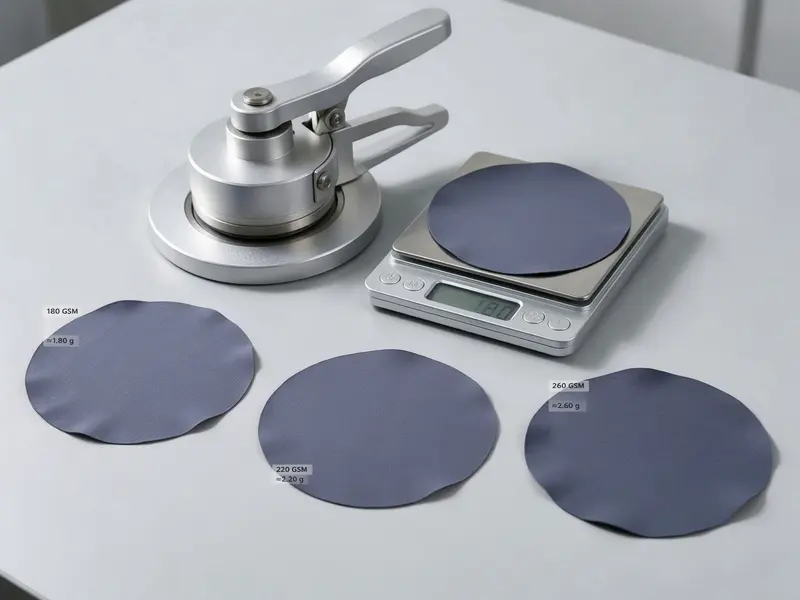
Ask every supplier for the GSM tolerance in writing — fabric should arrive close to the number quoted, not “in that range somewhere.” A spec without tolerance is a guess with a unit.
Stretch vs Recovery: Why “4-Way” Is Not Enough
“4-way stretch” only tells you the direction of the stretch. It says nothing about whether the fabric bounces back. Recovery is the number that keeps knees from bagging, waistbands from drooping, and butts from sagging.
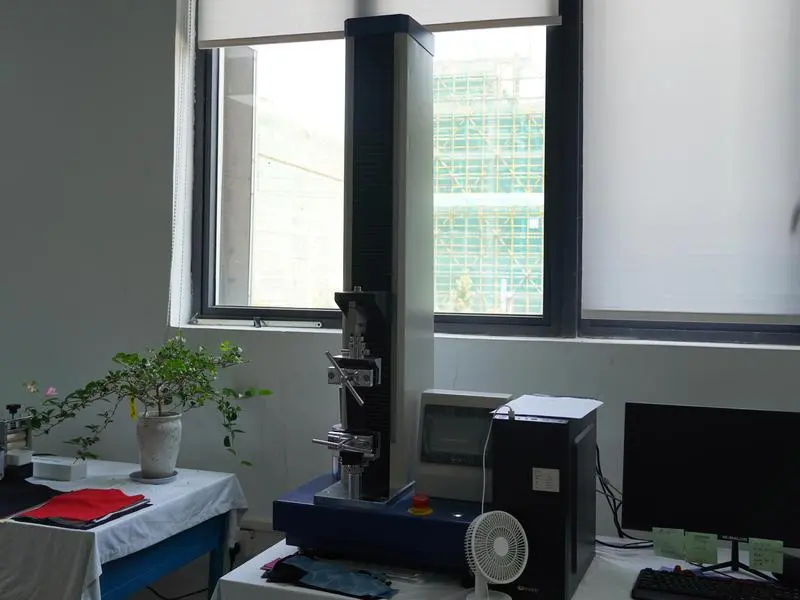
When you sample, do the hand test: stretch it hard, hold for three seconds, release, and watch the surface. Then ask the mill for elongation and recovery data — we test recovery on every new fabric and keep the result on the spec sheet.
A fabric that stretches but does not recover is a fabric that forgets its job.
Color Is a Fabric Decision Too: Stock vs Custom Dye
Color is not a finish you pick at the end; it changes the fabric you need. Two rules of thumb: lighter shades demand higher GSM for opacity, and custom colors change your MOQ and your lead time.
Stock colors are dyed already — low MOQ, fast sampling, easy to reorder. Custom dye starts with a lab dip, then the mill dyes your shade in bulk with a higher fabric MOQ. Budget for both before you fall in love with a Pantone number.
Dye lots are the quiet risk. Two batches of the same color are never identical, which is why we order one shade in one dye lot when possible, shade-match across lots, and confirm a fresh lab dip before every reorder. A supplier who cannot talk about dye lots in writing is a supplier you will argue with about color later.
The 5-Step Fabric Decision Checklist
Copy this checklist into your tech pack. Five steps, and you will never order “something like the last sample” again.
| # | Step | Why it matters |
|---|---|---|
| 1 | Lock the use case: yoga, training, or lounge | The fabric must match the movement and the price |
| 2 | Match fiber to budget and handfeel target | Nylon blends cost more; polyester starts cheaper |
| 3 | Set GSM against color and opacity needs | Light shades need 200 gsm or above |
| 4 | Ask for stretch-and-recovery test data | 4-way tells direction; recovery tells durability |
| 5 | Freeze one fabric code and test a sample before bulk | Fabric codes make reorders a conversation, not a guess |
Table 3 5-step fabric decision checklist
Here is the start of our own library — real codes, real composition, the same table our team quotes from.
| Code | Composition | GSM | Best use | MOQ |
|---|---|---|---|---|
| GZ8012-1 | 70% Nylon / 30% Elastane | 210 | Leggings, bras, tops, jackets | 300 m/color |
| GZ8012 | 70% Nylon / 30% Elastane | 210 | Leggings, bras, tops, jackets | 300 m/color |
| GZ2330N | 75% Nylon / 25% Lycra | 220 | Leggings, bras, tops, jackets | 600 m/color |
| GZ55993SM | 80% Polyester / 20% Elastane | 235 | Leggings, bras, tops, jackets | 600 m/color |
| GZ9336 | 80% Nylon / 20% Elastane | 235 | Leggings, bras, tops, jackets | 600 m/color |
| GZ6031-2 | 88% Polyester / 12% Elastane | 205 | Swimwear | 300 m/color |
| GZ55826 | 78% Nylon / 22% Lycra Sport | 125 | T-shirts | 600 m/color |
Table 4 Our fabric library at a glance — source: LAVYSEN fabric library, October 2026.
Buyer FAQ
Can I reorder the exact same fabric later?
Yes — that is what a fabric code is for. Reorders use the same code, same mill, and same construction so handfeel and performance stay consistent. Ask your supplier to commit to that in writing.
What is the fabric MOQ, not just the garment MOQ?
Fabric MOQ is what limits your first order, not the sewing line. Our stock fabrics start at 300–600 m per color, depending on the code; custom dye runs are higher. Ask for both numbers before you plan quantities.
Do you test stretch, shrinkage, and color fastness before bulk?
We run internal checks on every development — pilling and colorfastness graded 4 under European Standard methods, wash shrinkage within 3% — and third-party reports (SGS, Intertek) are arranged per order. The report should carry the same fabric code you order — that is the only way the data means anything.
If I use recycled fabric, what documents do I need?
For GRS claims, you need the supply-chain transaction certificate for your batch, not just a logo. Note: GRS 4.0 is current, and Textile Exchange's new Materials Matter Standard becomes effective December 31, 2026 and mandatory a year later [3].
Shopper FAQ
Is 220 gsm always better than 180 gsm?
No. GSM is weight, not quality. A 180 gsm tank is perfect for the gym; a 180 gsm legging in a light color may not pass the squat test. Match GSM to the garment and the color, not to a “bigger is better” rule.
Why do light-colored leggings go see-through?
Opacity depends on GSM, color, and stretch. The fabric gets thinner when stretched, and light colors reveal more. That is why we recommend 200 gsm or above for light shades — and a squat test before bulk.
Sources
[1] ISO 2076:2021, Textiles — Man-made fibres — Generic names (7th edition). https://www.iso.org/standard/79685.html
[2] OEKO-TEX® STANDARD 100 — label for textiles tested for harmful substances, from yarn to finished product; 4 product classes. https://www.oeko-tex.com/en/our-standards/oeko-tex-standard-100
[3] Textile Exchange — Standards Policy & Resource Updates: Materials Matter Standard effective December 31, 2026, mandatory December 31, 2027 (GRS/RCS transition). https://hub.textileexchange.org/home/site-wide-content/standards-policy-updates
[4] LAVYSEN factory fabric library and product knowledge manual (industry ranges: leggings 180–250 gsm; spandex 15–25%; light shades 200 gsm or above) — reviewed October 2026.
Ready to lock your fabric the right way? Request a 1-piece sample or a fabric swatch pack — we will send the codes, the specs, and the test plan with it. [Contact our team] (https://www.lavysen.com/contact).