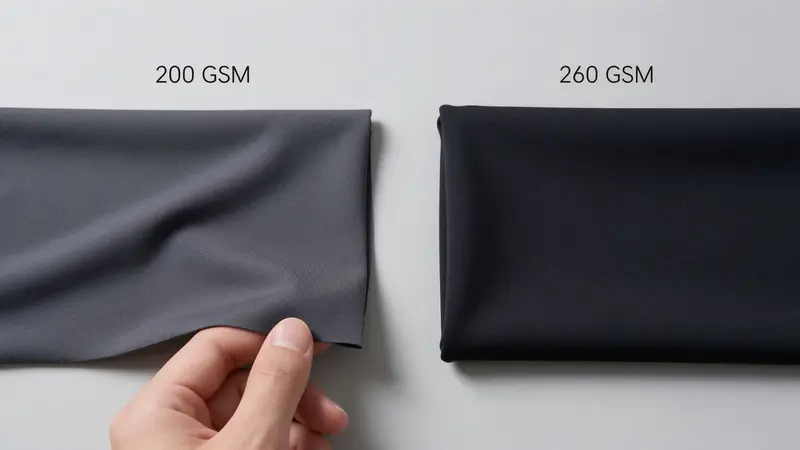
You spec a pair of yoga leggings. The fabric arrives. It feels thin — almost sheer when stretched. Or it feels heavy and stiff, like a hoodie, not something you'd sweat in.
GSM is the single number that predicts both. Get it right and your fabric sample matches your product concept on the first try. Get it wrong and you re-sample — and lose 7–10 days.
WHAT DOES GSM ACTUALLY MEAN?
GSM stands for Grams per Square Meter — the weight of one square meter of fabric, measured in grams. It is the industry standard for describing fabric density.
A 200 GSM fabric means one square meter weighs 200 grams. A 260 GSM fabric is denser and heavier. But GSM measures weight, not thickness directly. Two fabrics can have the same GSM and feel completely different — because of knit structure, fiber type, and yarn quality.
A single-ply 220 GSM polyester may feel thinner than a brushed-back 220 GSM nylon-spandex blend. That is why GSM is a starting specification, not the whole story.
WHAT GSM RANGE FITS WHICH PRODUCT?
Table 1 — Recommended GSM ranges by activewear category
| Product category | Recommended GSM | Feel & performance | Watch out for |
|---|---|---|---|
| High-waist compression leggings | 220–260 | Opaque, supportive, structured | Below 200 = see-through |
| Everyday yoga leggings | 200–230 | Soft, balanced, breathable | Below 180 = sheer when stretched |
| Sports bra (medium support) | 200–240 | Comfortable, enough bust support | Too low = no support |
| Sports bra (high support) | 240–280 | Firm compression, bounce control | Above 300 = too rigid |
| Yoga tank / crop top | 160–200 | Lightweight, non-restrictive | Below 140 = sheer |
| Tennis dress / skort | 180–220 | Light, opaque enough for movement | Below 160 = see-through on bends |
| Biker shorts / running shorts | 180–220 | Quick-dry, sweat-wicking | Below 160 = pills fast |
| One-piece swimsuit | 180–220 | Snug, chlorine-resistant | Too low = baggy in water |
These are typical starting points. Your exact number depends on composition (nylon vs. polyester), knit type (single jersey vs. double-knit), and any special finish (brushed, peached, compressive). For more on how composition changes the feel, see our guide to choosing the right fabric.
WHY DOES GSM MATTER FOR ACTIVEWEAR?
Activewear is not a t-shirt. It needs to stretch, recover, wick sweat, and not go see-through when you bend over. GSM directly affects all of these:
- Opacity: Lower GSM fabrics turn sheer when stretched — especially dark colors on lighter skin tones.
- Compression: Higher GSM provides more structure and support — critical for sports bras and high-waist leggings.
- Breathability: Lower GSM breathes better — ideal for hot yoga and high-intensity running.
- Durability: Fabrics below the recommended range pill faster and seam-break more easily.
- Hand feel: A 220 GSM brushed-back legging feels noticeably more premium than a 180 GSM smooth jersey of the same composition.
Getting GSM wrong means re-sampling. Each revision adds 7–10 days and pushes your delivery date back. Specifying the right range from day one saves time and money.
WHAT HAPPENS WHEN GSM IS TOO LOW OR TOO HIGH?
Table 2 — Too low vs. too high: what goes wrong
| GSM too low | GSM too high | |
|---|---|---|
| Opacity | Sheer when stretched — dark leggings go see-through in a squat | Fully opaque, no issue |
| Feel | Thin, flimsy, cheap-feeling | Stiff, restrictive, like a hoodie |
| Support | Waistbands lose elasticity after a few wears | Too firm — you cannot move freely |
| Breathability | Breathes well | Traps heat — too warm for hot yoga |
| Durability | Pills fast, inner thighs wear out | Durable but heavy on the body |
| Cost | Cheaper per meter | More fiber = higher fabric cost |
The goal is not "heavier is better." It is matching GSM to the product's function and price point. A 200 GSM nylon-spandex yoga legging can feel far more premium than a 280 GSM basic polyester.
HOW TO SPECIFY GSM IN YOUR TECH PACK
The cleanest way to avoid re-sampling: write the GSM range directly in your Tech Pack, not just a single number.
Example Tech Pack entry:
> Fabric: 75% Nylon 25% Spandex, 4-way stretch > Target GSM: 220–240 GSM > Tolerance: ±10 GSM > Finish: Brushed back, matte > Test: Opacity test required on black and navy samples
Why use a range instead of a fixed number? Fabric mills naturally vary ±5–10 GSM from batch to batch. A range gives the factory flexibility to source from available stock lots. A fixed 220 GSM target may force the mill to weave a special lot — raising MOQ and cost.
Always pair GSM with composition, stretch direction, and finish. A 220 GSM double-knit compression fabric and a 220 GSM single-jersey t-shirt fabric have the same weight but completely different uses. For a full checklist of what to include, see our concept-to-sample guide.
KEY TAKEAWAYS
- GSM = grams per square meter: the baseline fabric weight number every activewear buyer should specify.
- Leggings need 220–260 GSM for opacity and support; tops need 160–200 GSM for breathability.
- Specify a range (±10 GSM) in your Tech Pack, not a single fixed number.
"GSM is the fabric's weight, not its personality. Composition, knit, and finish decide how it actually feels on the body."
FAQ
1. Is higher GSM always better quality?
No. Higher GSM means heavier fabric, not better quality. A 200 GSM nylon-spandex yoga legging can feel far more premium than a 280 GSM basic polyester. Match GSM to the product's function.
2. Why does my black legging go see-through but the navy one doesn't?
Dark colors on lighter skin tones show through more easily. Always require an opacity test on black and navy samples, and specify a minimum GSM that prevents sheer-on-stretch.
3. Can I request a custom GSM for my product?
Yes, but weaving a special GSM often raises MOQ. If you are starting with a 300-piece order, choose from the mill's standard stock GSM range (±10 GSM tolerance) to keep costs and lead times predictable.
4. Does GSM change after washing?
It can shrink by 2–5% after the first wash, which slightly increases effective GSM. This is normal and accounted for in pre-shrunk fabric. Ask the mill if the GSM number is measured before or after pre-shrinkage.
SOURCES
[1] ASTM D3776: Standard Test Methods for Mass Per Unit Area (Weight) of Fabric. ASTM International. [2] ISO 20732: Textiles — Knitted fabrics — Determination of mass per unit length and mass per unit area. ISO.
REQUEST A FABRIC SAMPLE
Not sure which GSM and composition fits your product? Send us your product concept and target price point. We'll recommend the right fabric spec and send swatches before you commit to bulk.
ABOUT LAVYSEN
Lavysen is an activewear manufacturer based in Ningbo, China, specializing in OEM / ODM private-label yoga wear, sports bras, tennis apparel, and swimwear. We work with US and European fitness and fashion brands from Tech Pack through bulk production, with controlled quality at every stage.