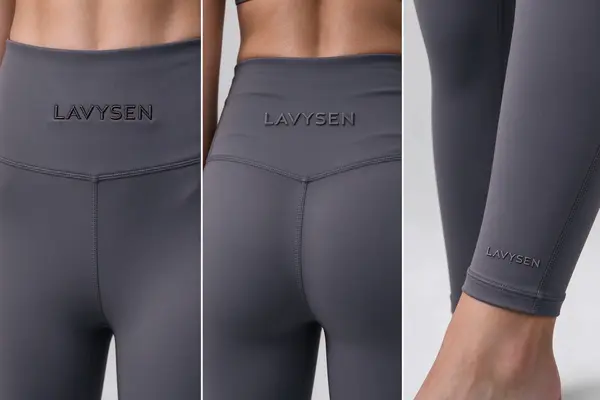
Logo Customization Options for Activewear
You nailed the fabric, the cut, and the color. Then the factory asks: “How do you want your logo done?” Most buyers freeze right there — because nobody showed them the difference between embroidery and a silicone patch.
Four processes do 95% of activewear logo work: embroidery, silicone patches, screen print, and heat transfer. Each one changes cost, durability, MOQ, and how the logo survives 50 washes. Here is how to pick yours.
What Actually Decides Logo Quality?
Logo quality is decided before the machine runs. Five variables control the outcome: placement, substrate, process, size, and color fastness.
Placement decides which process can work — a waistband that stretches needs a flexible logo, a mesh top needs a soft one. Substrate is the fabric under the logo; thick nylon takes embroidery well, sheer mesh does not.
Process sets the look and the cost. Size changes unit cost more than people expect: a tiny 2 cm logo can cost more per piece than a large chest print, because setup time does not shrink with the design. Color fastness is the number you never see until wash 20 — that is where ISO 105-C06 comes in[2].
The same artwork can look premium on one fabric and cheap on another. Match the process to the placement, and the logo becomes part of the garment — not a sticker on it.
Embroidery: The Premium Default
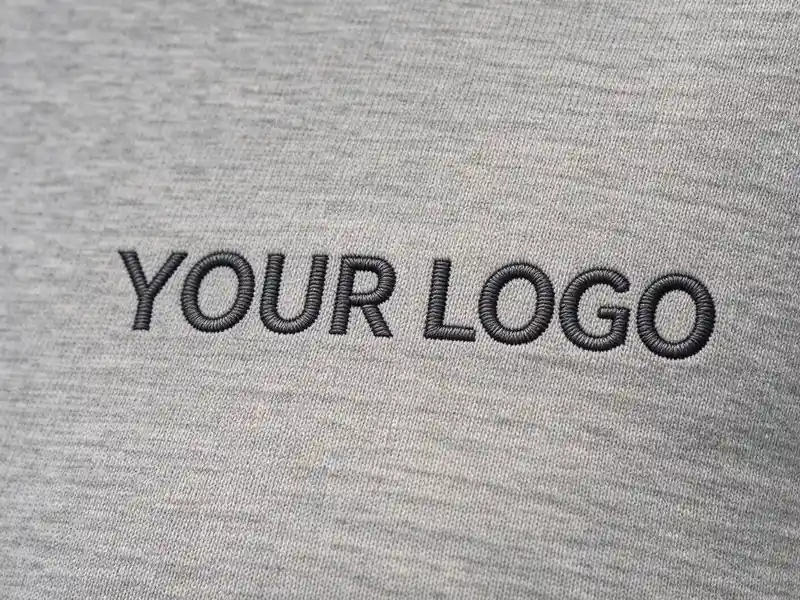
Embroidery is the default choice when a brand wants “premium” in one word. It reads expensive, it survives washing, and it looks deliberate on waistbands, back yokes, and hip areas.
Two numbers matter: stitch density and area. Density decides the raised, structured look; area decides cost. Small logos cost more per piece than big ones, because every design pays for hoop setup[1]. ISO 4915 keeps the stitch vocabulary standard across mills, so “lockstitch” means the same thing in Ningbo and in Los Angeles[1].
The watch-out is the substrate. Embroidery on thin mesh or lightweight tanks puckers, and the backing can itch against skin. We back embroidery with film or interlining when the fabric needs it — a cost most quotes hide until sampling.
Sampling: embroidery logo sample takes 7 days. No standalone logo MOQ (garment MOQ applies: 500 pcs per color, 1,000 pcs per style); no thread-color limit.
Silicone and PVC Patches: The Yoga-Studio Favorite
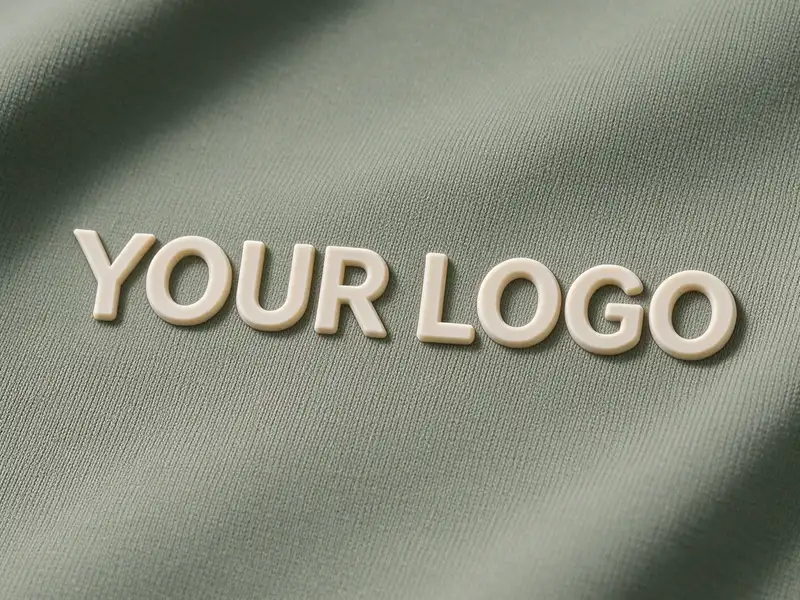
If you have bought yoga wear in the last five years, you have seen this one: a smooth, raised 3D logo on the waistband or back waist. Silicone patches are the yoga-studio favorite because they look clean, stay flexible, and do not irritate skin.
Silicone beats PVC on feel and aging: it stays soft, resists yellowing, and hugs curved seams. PVC is harder, glossier, and cheaper, but it stiffens and can crack in cold. Both are applied by heat press or ultrasonic bonding, so the patch moves with the fabric instead of fighting it.
Because the patch is molded, most suppliers charge a one-time mold fee — we charge none, but a 200 RMB dyeing charge applies per color. No standalone MOQ (garment MOQ applies).
Screen Print and Heat Transfer: The Budget Workhorse
When budget leads and the design is flat, screen print and heat transfer carry the line. Screen print handles big color blocks at low per-piece cost; heat transfer handles small runs, gradients, and photo-level detail.
The trade-off is durability. Prints sit on the surface, so they fade and crack faster than embroidery or molded patches — which is exactly what ISO 105-C06 measures when we test wash fastness[2]. On stretch zones, a printed logo can crack where a patch would flex; on light fabrics, heat transfer prints more reliably than screen.
Setup cost is RMB 500 per screen/color for screen printing; heat transfer carries a 200 RMB dyeing charge. Neither process has a standalone MOQ (garment MOQ applies).
Woven Labels, Hang Tags, and the Details That Finish a Brand
The logo is not only the patch on the waistband. Woven labels, hang tags, and packaging finish the brand system — and buyers notice them more than they admit.
A woven label (the main label under the care label) carries your brand name in thread that survives washing; a jacquard weave keeps even tiny type crisp. Hang tags carry the story your patch cannot: fabric code, care instructions, traceability. They cost little and raise perceived value a lot.
Rule of thumb: treat every printed or woven element as part of one spec system, with the same Pantone codes and the same artwork files. Fragments of mismatched branding cost more than any label.
Woven labels: no MOQ, sample fee RMB 500 per design; hang tags: no MOQ, sample fee RMB 500; our standard tag material is 350gsm card with matte lamination.
How to Spec Your Logo in a Tech Pack
A logo spec is eight lines long. Fill all eight and the factory cannot guess — which is where most logo problems start.
| # | Spec item | What to write |
|---|---|---|
| 1 | Artwork file | AI/PDF, vector, 1:1 scale, with bleed |
| 2 | Finished size | Width × height, plus tolerance |
| 3 | Placement | Distance from waistband seam or cuff |
| 4 | Color | Pantone codes — never “brand red” |
| 5 | Process | One process per placement area |
| 6 | Substrate | Fabric type the logo sits on |
| 7 | Test requirement | Wash fastness (ISO 105-C06), adhesion |
| 8 | Reference sample | One approved sample to match |
Table 1 Logo spec checklist
Two extra rules from the factory floor. First, lock one process per placement: a waistband that is half silicone and half embroidery is two quotes and two failure modes. Second, approve one physical sample before bulk — a photo of a logo on a phone is not a standard.
A logo is not a decoration; it is a durability claim you make in thread, silicone, or ink. Spec it the way you spec the fabric — and it will still look right after fifty washes.
Logo Process Decision Matrix
| Process | Look & feel | Durability | Cost level | Entry MOQ | Best for |
|---|---|---|---|---|---|
| Embroidery | Premium, raised | High | Mid–high | None* (garment MOQ) | Waistbands, back yoke, thick fabrics |
| Silicone patch | 3D, smooth, flexible | High | Mid | None* (garment MOQ) | Waistbands, back waist, studio lines |
| PVC patch | Hard, glossy | Mid | Mid | None* (garment MOQ) | Sporty patches, brand blocks |
| Screen print | Flat, matte | Mid | Entry | None* (garment MOQ) | Chest, large color blocks |
| Heat transfer | Photo-grade, smooth | Mid–low | Entry | None* (garment MOQ) | Small runs, gradients, light fabrics |
Table 2 Logo process decision matrix
Buyer FAQ
What is the MOQ for each logo process?
MOQ follows the process, not the brand. Embroidery pays for hoop time; silicone and PVC pay for a mold first. On our side, no logo process has a standalone MOQ — the garment MOQ applies (500 pcs per color, 1,000 pcs per style). Ask for the process MOQ and the mold cost as two separate numbers; we charge no mold fee, and silicone patches and heat transfer carry a 200 RMB dyeing charge.
Can I reorder the exact same logo later?
Yes — if the file, process, Pantone codes, and placement are locked in the tech pack. Vector artwork plus one approved physical sample is what makes reorders identical.
Do you test logo durability before bulk?
We run wash fastness per ISO 105-C06 and rubbing per ISO 105-X12, plus adhesion/peel checks on the approved sample before bulk, and a 20-wash cycle check on the first bulk order.
Can I combine several processes on one garment?
Yes, but spec each placement separately. Multiple processes mean multiple quote lines and multiple failure modes — approve each one on a physical sample.
Shopper FAQ
Will the logo crack or peel after washing?
It depends on the process. Embroidery and silicone patches hold up far longer than prints; heat transfer fades gradually. Wash inside-out and avoid high-heat drying to slow the aging of any logo.
Does a silicone patch feel uncomfortable against skin?
A well-placed patch should not. Waistband and back-waist patches are designed with smooth edges and flexible silicone; the material sits on the outside of the garment for most placements.
Sources
[1] ISO 4915:1991, Textiles — Stitch types — Classification and terminology (2nd edition, ISO/TC 38). https://www.iso.org/standard/10932.html
[2] ISO 105-C06:2010, Textiles — Tests for colour fastness — Part C06: Colour fastness to domestic and commercial laundering (4th edition). https://www.iso.org/standard/51276.html
[3] OEKO-TEX® STANDARD 100 — label for textiles (incl. printed/coated materials) tested for harmful substances, from yarn to finished product. https://www.oeko-tex.com/en/our-standards/oeko-tex-standard-100
[4] LAVYSEN factory logo-process price list, sampling records and stitch-spec sheets — October 2026. MOQ, mold fees, sampling lead time and test-method details confirmed against factory records.
Ready to lock your logo the right way? Request a sample with two processes side by side — embroidery and silicone on the same waistband — and feel the difference before you decide. Get a quote — https://www.lavysen.com/contact/#rfq. Explore our fabrics (https://www.lavysen.com/fabrics), products (https://www.lavysen.com/products) and contact (https://www.lavysen.com/contact).