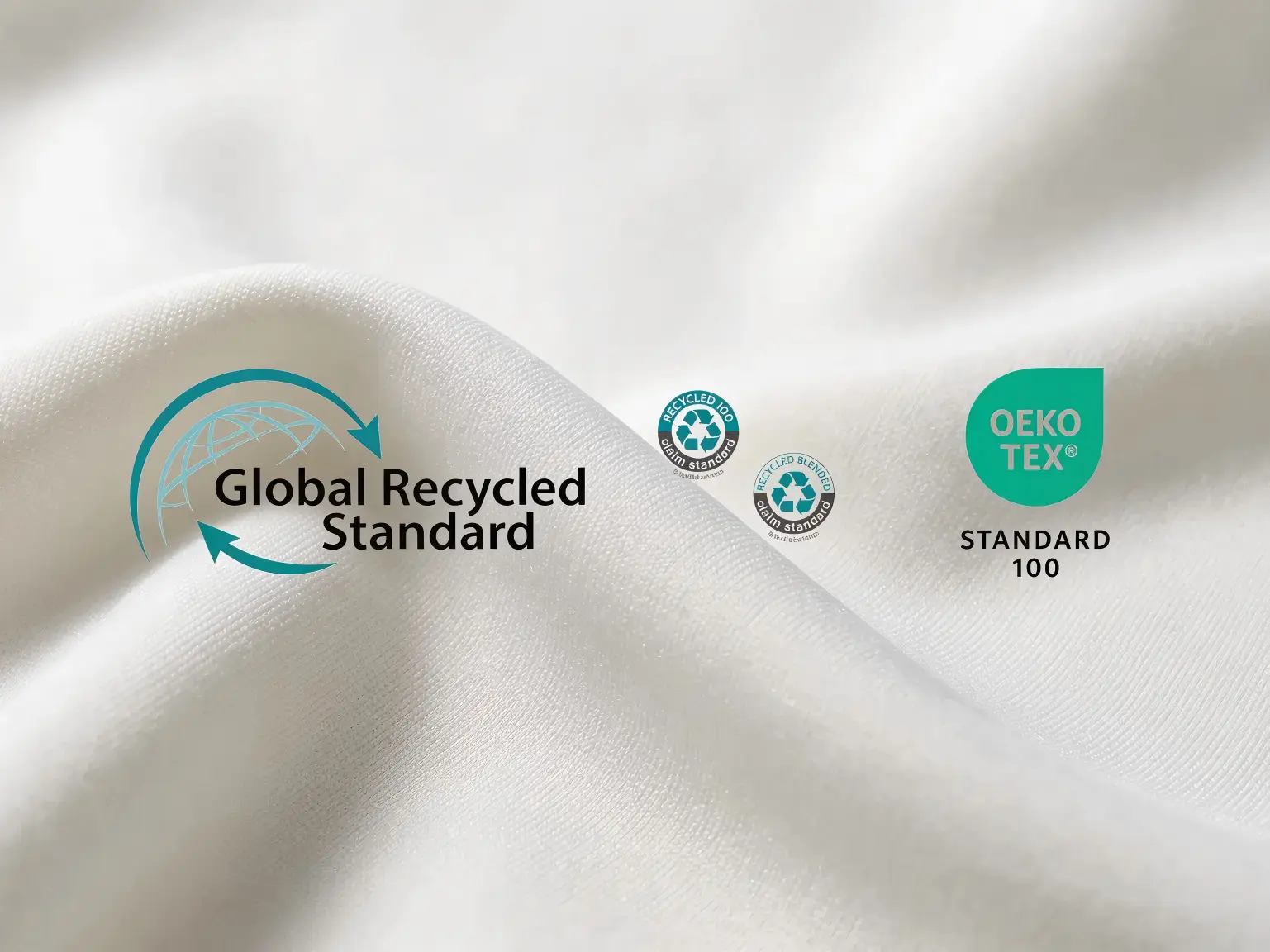
You see "GRS certified," "RCS certified," and "OEKO-TEX certified" on activewear tags. But what does each one actually cover? And which one matters for your brand?
GRS covers recycled content and the supply chain behind it. RCS confirms recycled material but skips the chain-of-custody audit. OEKO-TEX tests for harmful substances — it has nothing to do with recycled content. They solve three different problems.
What Is GRS (Global Recycled Standard)?
GRS is the most comprehensive recycled-content certification. It is run by Textile Exchange and covers four areas:
| Area | What GRS Checks |
|---|---|
| Recycled content | Minimum 20% recycled material in the final product |
| Chain of custody | Traceability from recycled input to finished garment |
| Environmental practices | Chemical use, wastewater, energy management at the mill |
| Social criteria | Labor conditions, fair wages, working hours |
GRS is the gold standard if your brand makes sustainability claims on the product page. It requires a transaction certificate at every step — from recycled fiber supplier to spinning mill to knitting factory to garment factory.
What it does not cover: Product safety (that is OEKO-TEX), and biodegradability or circularity claims.
What Is RCS (Recycled Claim Standard)?
RCS is also from Textile Exchange, but it is a lighter version of GRS.
| Area | RCS | GRS |
|---|---|---|
| Recycled content minimum | 5% | 20% |
| Chain of custody | Yes | Yes |
| Environmental audit | No | Yes |
| Social criteria | No | Yes |
| Transaction certificate | Yes | Yes |
RCS confirms that the material contains recycled content. It does not audit the factory's environmental or social practices. Brands use RCS when they want to make a "made with recycled material" claim but do not need the full GRS audit.
When to choose RCS instead of GRS: If you are a small brand making a "recycled" claim on a product page, RCS is cheaper and faster to obtain. If you are selling to retailers like Patagonia or Adidas, they will require GRS.
What Is OEKO-TEX Standard 100?
OEKO-TEX Standard 100 is not a recycled-content certification. It is a product safety test.
| What OEKO-TEX Checks | What It Does Not Cover |
|---|---|
| Heavy metals (lead, cadmium) | Recycled content |
| Pesticides | Chain of custody |
| Formaldehyde | Factory labor practices |
| Phthalates | Environmental management |
| pH level | Energy or water use |
OEKO-TEX tests the finished fabric or garment for harmful substances. It classifies products by use category — baby products, direct skin contact, indirect skin contact, decorative. The higher the category, the stricter the limits.
Key point: A fabric can be both OEKO-TEX certified and GRS certified. They test different things. OEKO-TEX says "this fabric is safe to wear." GRS says "this fabric is made with recycled material and the supply chain is audited."
How to Choose the Right Certification for Your Brand
| Your Situation | Choose |
|---|---|
| Selling to major retailers (Patagonia, Adidas, etc.) | GRS |
| Making a "recycled" claim on your DTC product page | RCS or GRS |
| Customers ask "is this fabric safe / non-toxic?" | OEKO-TEX Standard 100 |
| You want both recycled AND safe fabric | GRS + OEKO-TEX (separate certs) |
| Budget is tight, small batch order | RCS first, add GRS later |
How to Verify a Certificate in 60 Seconds
Any factory can say "we are GRS certified." Here is how to check if the certificate is real and covers your specific product:
1. Ask for the certificate number — not just a photo of the logo.
2. Go to the Textile Exchange database (or the OEKO-TEX database for product safety certs).
3. Enter the certificate number. Check:
- The certificate is not expired
- The product category matches what you are ordering
- The factory name and address matches the supplier you are working with
- The material type is covered (nylon, polyester, cotton — not all mills are certified for all fibers)
If the factory cannot provide a certificate number, or if the database entry does not match your order, the "certified" claim is not verified.
What We Offer
At our factory, we work with GRS-certified recycled nylon and recycled polyester mills. We can provide:
- GRS transaction certificates for orders of GRS-certified recycled fabric
- OEKO-TEX Standard 100 test reports for fabric safety
- Fabric swatches in recycled and virgin options, so you can compare hand feel
We do not carry RCS as a separate certification — most of our customers require GRS for retailer compliance.
Three certifications solve three problems. Do not ask for GRS when you need OEKO-TEX — and do not think OEKO-TEX means the fabric is recycled. Know which problem you are trying to solve.
FAQ
Q: Can a fabric be both GRS and OEKO-TEX certified?
A: Yes. They test different things. GRS verifies recycled content and supply chain. OEKO-TEX verifies the fabric does not contain harmful chemicals. Many premium recycled fabrics carry both.
Q: What is the minimum recycled content for GRS?
A: 20% recycled material in the final product. The remaining 80% can be virgin or other fibers. RCS requires only 5%.
Q: How long does GRS certification take?
A: The mill or factory must already be audited. If you are ordering from a GRS-certified mill, the transaction certificate is typically issued within a few business days. Getting a factory initially certified takes several months of preparation and audit.
Q: Is OEKO-TEX better than GRS?
A: They are not comparable. OEKO-TEX is a safety test. GRS is a recycled-content and supply-chain audit. You need OEKO-TEX if customers ask about chemicals or skin safety. You need GRS if customers ask about recycled content.
Buyer FAQ (B2B)
Q: Can we get GRS-certified fabric for a 300-piece order?
A: Yes. We work with GRS-certified recycled nylon and polyester mills. The transaction certificate is included at no extra cost for orders above the mill's minimum quantity; smaller orders can still obtain it at the mill's standard certificate fee.
Q: Do you provide OEKO-TEX test reports?
A: Yes, we can share the latest OEKO-TEX Standard 100 test report for the fabric you are ordering. The report covers heavy metals, formaldehyde, pH, and other substances.
Key Takeaways
1. GRS = recycled content + supply chain audit + environmental and social checks. The gold standard for sustainability claims.
2. RCS = recycled content only. Cheaper, lighter, suitable for DTC brands that do not sell to major retailers.
3. OEKO-TEX = product safety. It has nothing to do with recycled content. It tests for harmful chemicals.
See Certifications for Yourself
Send us your fabric spec. We will share GRS transaction certificates, OEKO-TEX test reports, and fabric swatches in recycled and virgin options.
Sources
1. Textile Exchange. (2025). Global Recycled Standard (GRS) and Recycled Claim Standard (RCS) v4.0. textileexchange.org.
2. OEKO-TEX. (2025). Standard 100 Product Safety Certification. oeko-tex.com.